STEM Labs vs. Makerspaces:
What’s the Difference and Which Does Your School Need?
As schools are being asked to invest in dedicated STEM spaces, the varied terminology that’s out there isn’t making decisions any easier. STEM lab, makerspace, fab lab, innovation lab: these terms are frequently used interchangeably, but they don’t necessarily describe the same thing. That ambiguity comes with consequences for administrators and curriculum directors who are trying to make responsible, lasting decisions about space, budget, and programming.
To help clear up any confusion, we’ll take a closer look at both STEM labs and makerspaces, exploring what they are and comparing them across the touch points that matter most for schools.
What Is a STEM Lab?
A STEM lab is a dedicated learning space within a school where students can explore science, technology, engineering, and math through structured, hands-on activities tied to specific curriculum goals and measurable learning outcomes. Unlike a typical classroom, a STEM lab offers an intentionally designed environment that connects academic concepts to real-world problem solving, giving learners the tools, space, and guided instruction to apply lessons across disciplines.
Structured Learning With a Purpose
The defining characteristic of a STEM lab is intentionality. Every activity, piece of equipment, and project connects back to specific learning objectives. Facilitators guide students through challenges designed to progressively build skills, which means that what happens in a STEM lab isn’t left to chance. Instead, it’s planned, scaffolded, and aligned to the standards districts are already accountable for.
That intentional curriculum alignment is what separates a true STEM lab from a room filled with interesting tools and equipment. A well-designed STEM lab is both a place to conduct experiments and one where those experiments serve a specific learning purpose.
What Happens in a STEM Lab?
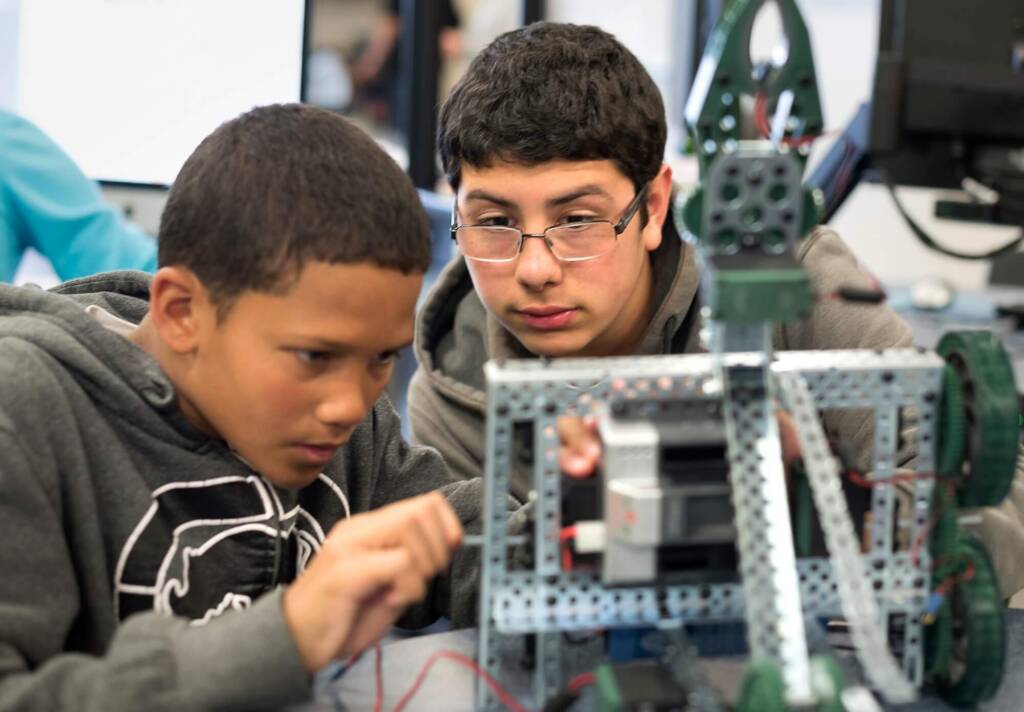
The activities that happen in a STEM lab are dynamic. Here, students could be programming robots to complete a navigation challenge and running experiments to test variables in a physics problem one day, then designing and iterating on engineering prototypes and exploring computational thinking through coding platforms the next. While the activities vary, the common thread is that they’re structured, facilitated, and tied to measurable outcomes.
Who Does a STEM Lab Serve?
Because STEM labs are facilitator-guided, they’re designed to serve all K–12 students, not just those who already identify as “STEM kids.” The curriculum meets students where they are and builds their skills systematically, which makes STEM labs particularly effective for reaching students who might not naturally gravitate toward open-ended exploration.
STEM Labs and Career Readiness
Curriculum alignment also positions STEM labs to directly connect to career and technical education pathways. Learners develop subject-matter knowledge alongside the critical thinking, collaboration, and problem-solving skills that professionals in STEM careers use every day.
What Is a Makerspace?
A makerspace is a collaborative learning environment where students come together to design, build, tinker, and create using a wide range of tools and materials, from high-tech equipment like 3D printers to basic supplies such as cardboard and craft materials. In a school setting, a makerspace prioritizes learner agency, open-ended exploration, and the process of creating. Here, the process is the purpose, completely separate from predetermined outcomes.
The Maker Movement and Where It Comes From
The makerspace concept grew out of the broader maker movement—a cultural shift that celebrates hands-on creation, DIY problem-solving, and learning by doing. As that ethos entered schools, it brought a values shift with it, from passive consumption of lessons to the active production of knowledge.
The Maker Mindset
The maker mindset is a creativity-first orientation that values curiosity, iteration, and learning from failure. In a makerspace, there’s no single “right” answer; students are encouraged to experiment, revise their work, and take ownership of what they create. The goal in a makerspace isn’t a flawless finished product, but the learning that occurs through the process of creating.
What Learners Do in a Makerspace
Makerspace activities intentionally look different every day. At any given time, students might be designing and printing a custom enclosure on a 3D printer, building a working circuit from scratch, creating stop-motion animation, laser cutting a prototype, or pursuing a self-directed project that may or may not fit with any existing subject. The open-endedness is a key component of a makerspace.
Common Makerspace Tools and Materials
A typical makerspace within a school might include 3D printers, laser and vinyl cutters, sewing machines, electronics and microcontroller kits, craft supplies, and recyclable materials. They include a wide range of items on purpose, since makerspaces are designed to be inviting for students with diverse interests and skill sets.
What Makerspaces Do for Students
Well-run makerspaces build student agency and ownership over learning, strengthen collaboration and communication, improve creative confidence, and develop a growth mindset through iteration. These are the skills employers look for, and makerspaces develop them in an environment where students enjoy being.
Fab Labs, Hackerspaces, and Makerspaces: What’s the Difference?
These terms frequently overlap, and chances are high that you’ll encounter all three in your research. A fab lab (short for fabrication laboratory) is a specific makerspace developed at the Massachusetts Institute of Technology (MIT) that includes a standardized set of digital fabrication tools and is part of a global network. A hackerspace is typically a community-run space, often outside of schools, where anyone interested in technology can work on projects and learn from one another. Makerspace is the broadest term of the bunch and the one most commonly associated with K–12 education.
STEM LAB vs. Makerspace
For administrators trying to make the right decision for their schools, it’s helpful to know how the two environments stack up. Here’s a breakdown:
| STEM Labs | Makerspaces | |
|---|---|---|
| Purpose | Built around curriculum outcomes—students complete activities mapped to specific standards and learning goals | Built around open exploration—outcomes are less prescribed, and the learning emerges from the making process itself |
| Structure | Features a curriculum, sequence, and trained adult guiding students through challenges with intention | More student-directed, with adults in a support role rather than an instructional one |
| Assessment | Suited to standards-aligned assessment; you can measure what students learn and connect it to grade-level expectations | Tend toward portfolio or self-assessment models that capture process and growth rather than content mastery |
| Equipment | Use of specialized tools selected to support specific learning objectives | Prioritize a wide range of materials that invite experimentation across different interests |
| Flexibility | Follow a defined curriculum arc, which creates consistency across classrooms and grade levels | Open-ended by design; students pursue what interests them within the constraints of available tools and time |
| Who thrives? | All students, including those who need more scaffolding | Students who are already self-motivated (though a strong makerspace culture can cultivate that motivation over time) |
It’s important to keep in mind that these environments aren’t opposites. Pitting them against each other makes it easy to miss a key point: The best modern learning spaces don’t ask administrators to choose between structure and creativity or between outcomes and exploration. Many schools find that the most meaningful STEM experiences happen when both approaches are present—a structured curriculum that builds foundational skills, paired with the creative freedom to apply and extend those skills in open-ended ways.
Can a School Have Both? The Case for Integration
The short answer is yes, schools can have both a STEM lab and a makerspace. That said, the most innovative schools don’t just have both; they’re creating environments where the two approaches reinforce each other.
A student who spends time in a structured STEM lab building skills in robotics, data analysis, or engineering design arrives at an open-ended maker challenge with more to work with. Another who’s been encouraged to tinker and take creative risks is better prepared to engage with a structured STEM problem. These modes of learning are complementary.
Integrated STEM learning environments share a few consistent characteristics, including a sense of community that extends beyond individual projects, spaces designed for both collaboration and focused work, and a culture where ideas are free to be proposed, tested, and refined. They also invest in their educators. Whether the environment leans more toward a structured curriculum or open exploration, facilitators need training and ongoing support, plus a clear understanding of how to guide learners through both modes.
What to Look for in a Turnkey STEM Lab Solution
If you’re evaluating options for your school or district, the right solution should go beyond furnishing a room. Here’s what differentiates a program from a product:
- Curriculum alignment. Look for a solution that comes with a structured, standards-aligned curriculum. Tools without a learning framework put the full burden of program design on your staff.
- Professional development for facilitators. The quality of the facilitator can make or break any learning environment. A strong turnkey solution trains your staff at launch, and on an ongoing basis as the program grows.
- Physical flexibility. Schools have different spaces, student populations, and needs. A good STEM lab program offers environments that can be configured for different grade levels, class sizes, and instructional approaches.
- Ongoing support. Implementation support at launch is crucial. But what happens in year two? Look for solutions that provide curriculum updates, technical support, and a partnership model that stays engaged after the install is complete.
- Integration of both structured and maker-style learning. The best turnkey programs don’t require a choice. They’re designed to support both structured STEM instruction and open-ended exploration, giving students and facilitators the tools and curriculum to move between both.
How SmartLab Brings STEM Labs and Makerspaces Together
Rather than asking schools to choose between curriculum-aligned STEM instruction and maker-style creative exploration, SmartLab offers both in a single, integrated program. Across every configuration — Explorer, Pathfinder, Spark, and Studio — the same core values apply: learners have a say in how they approach challenges, projects are open-ended, career connections give the work purpose, and iteration through the design process is how learning happens. What sets each apart is the depth, focus, and breadth of exploration.
Here’s a closer look at each:
- SmartLab Explorer and Pathfinder are for schools looking to provide opportunities for career-connected project-based learning (PBL) with depth. Explorer (intended for grades K–5) and Pathfinder (6–8) expose learners to eight distinct industries (including health sciences; advanced manufacturing; construction and architecture; entertainment, arts and media; and more) using integrated STEM applications. Each unit centers on an open-ended challenge tied to a specific career pathway, enabling learners to come up with their own solutions. The structured curriculum arc ensures each student builds skills systematically throughout the year, while affording them the freedom to design, test, fail, iterate, and present their thinking.
- SmartLab Spark is for schools whose focus is on breadth and exploration. Available for grades K–12, Spark introduces learners to several areas within STEM, including, but not limited to, circuitry, robotics, software engineering, mechanics and structures, communication and media arts, and environmental technology. With Spark, productive variety is a central theme. On any given day, one group of learners could be building a bridge while another experiments with a drone. On the next, both groups might team up to explore audio engineering. Ultimately, Spark is the best fit for schools that want to promote career readiness by providing a broad spectrum of STEM experiences, developing digital literacy and adaptability, and encouraging learner curiosity.
- SmartLab Studio is a specialized environment focused on digital media, audio-visual production, and communication. In this configuration, learners develop production skills and discover how they connect to careers in entertainment, broadcasting, and media. The result is work that is distinctly their own and intended for a real audience.
Across all three programs, learners share the same core experience: an environment where they’re encouraged to make their own decisions, their ideas make an impact, and the result is uniquely theirs. At the end of the day, the question isn’t about which program is best. Instead, ask yourself which depth of career connection and breadth of exploration is right for your learners right now.
If you’re ready to learn more about bringing SmartLab to your school, our team is here to chat. Get in touch to begin the conversation. Or, to see what integrated PBL can look like in your school, and wondering what outcomes it can yield, our free eBook, Improving Outcomes With Project-Based Learning, is a great place to start.
FAQ
What is the difference between a STEM lab and a makerspace?
The difference between a STEM lab and a makerspace comes down to a matter of framework and focus. A STEM lab is a structured, curriculum-driven learning environment where students complete hands-on activities tied to specific academic standards and learning outcomes. A makerspace is a more open-ended, learner-directed space where creativity, experimentation, and the process of creating take priority. STEM labs emphasize guided instruction and measurable outcomes; makerspaces focus on agency, iteration, and creative exploration.
What is a turnkey STEM lab?
A turnkey STEM lab is a complete, ready-to-implement STEM learning solution that includes equipment and physical space design as well as curriculum, facilitator training, and ongoing support. The “turnkey” designation means schools don’t have to start their program from scratch—the provider delivers everything needed to launch and sustain an effective STEM learning environment.
Do schools need both a STEM lab and a makerspace?
No, schools don’t necessarily need a STEM lab and a makerspace. However, schools benefit most when their STEM learning environment incorporates elements of both. Structured curriculum builds foundational skills and ensures all students have access to rigorous material. Open-ended maker experiences build creativity, agency, and problem-solving. An integrated environment that provides both is ideal for K–12 learners.
What equipment does a school STEM lab need?
The equipment needed for a school STEM lab varies based on grade level, program goals, and available space. Most well-equipped STEM labs typically include robotics and programmable devices, computers or tablets with coding platforms, engineering design materials, and data collection tools. In integrated environments, fabrication tools like 3D printers, electronics kits, and crafting supplies are often included as well.
How much does it cost to set up a STEM lab?
How much it costs to set up a STEM lab depends on the size of the space, the scope of the curriculum, and the type of equipment needed. Many schools fund STEM labs through federal programs, state STEM grants, or fundraising. Our STEM program funding guide covers the most common sources in detail.
What is a fab lab, and how is it different from a makerspace?
A fab lab is a specific type of makerspace developed at MIT that follows a standardized model and is part of a global network of affiliated labs. Makerspace is a broader term that doesn’t require network affiliation or a specific equipment list. In K–12 school contexts, makerspace is the more commonly used term and usually the most accurate framing.