Schools + Partners + Students: How the SmartLab Partnership Model Works for Everyone
For school administrators, figuring out how to sustain a STEM lab after initial funding runs out is a persistent challenge. And the thought of pursuing partnerships to solve it can conjure up uncomfortable images of awkward asks, vague promises, relationships that feel transactional, and a one-off check that may or may not cover the program’s long-term needs. It’s a barrier that keeps many schools from pursuing community support at all.
But what if a lasting partnership didn’t have to start with a funding ask?
In the SmartLab model, partnerships aren’t a charity pitch or a one-time donation campaign. They’re a sustainability strategy that’s deliberately structured to keep great STEM programming alive and growing long after the initial investment—one where schools, community partners, and students are aligned around a shared goal. And when that goal is the focal point, the relationship starts to feel less like a transaction and more like a true partnership.
This blog post breaks down exactly how that works.
Why Schools Can’t Go It Alone
Schools that invest in STEM programs without a long-term sustainability plan risk falling into a version of the same pattern. Equipment gets purchased, and the initial excitement that’s there in year one begins to fade over time.
The teacher who ran the program moves on to another district. The curriculum gets stale because there’s no budget to update it. The 3D printer sits in the corner because no one has time for another professional development cycle. And the program that was supposed to transform student outcomes eventually becomes a line item that no one can justify.
The vision was there, but structural problems got in the way. More specifically, one-time investments (even significant ones) don’t create sustainable programs.
The SmartLab model can help stop this trend, but it works best when community partners are part of the equation from the start.

“Each SmartLab we fund is another step towards fulfilling our mission. We never know the impact this exposure may have on a child, and many times attending a school with a STEM curriculum lights a spark that encourages a career in STEM. These children are the future problem solvers, inventors, doctors, and designers and we are proud to support them.”
What SmartLab Brings to the Partnership
Before looking more closely at what partners can contribute to the partnership, it helps to understand what SmartLab brings to the table—it’s what makes the model much more than simply purchasing equipment and a curriculum.
- Unlimited licenses to LearningHub: Every student in the program has access to SmartLab’s curriculum platform. That access scales as enrollment grows without any additional cost.
- Ongoing professional learning: When a Facilitator eventually moves on, the program doesn’t leave with them. Ongoing professional development means their replacement is ready to fill the opening without interruptions to continuity.
- SmartLab Spot: This connected platform brings the entire SmartLab ecosystem together, providing Facilitators with curriculum resources, professional learning, and ongoing support via a user-friendly online portal. Through SmartLab Spot, Facilitators get direct access to LearningHub, tools, and the greater SmartLab community to help them build confidence and develop the skills needed to keep their programs running strong.
- A dedicated Success Team: This isn’t a sales rep who checks in twice a year. Schools get access to a dedicated partner who works alongside them to align the program with specific goals and the needs of the student population.
A SmartLab is an ecosystem, and partnership is what keeps that ecosystem healthy over time. This is what community funders are supporting when they invest.
What Partners Contribute (Beyond a Check)
While funding is a crucial part of any partnership, the most effective SmartLab partnerships involve much more than financial support.
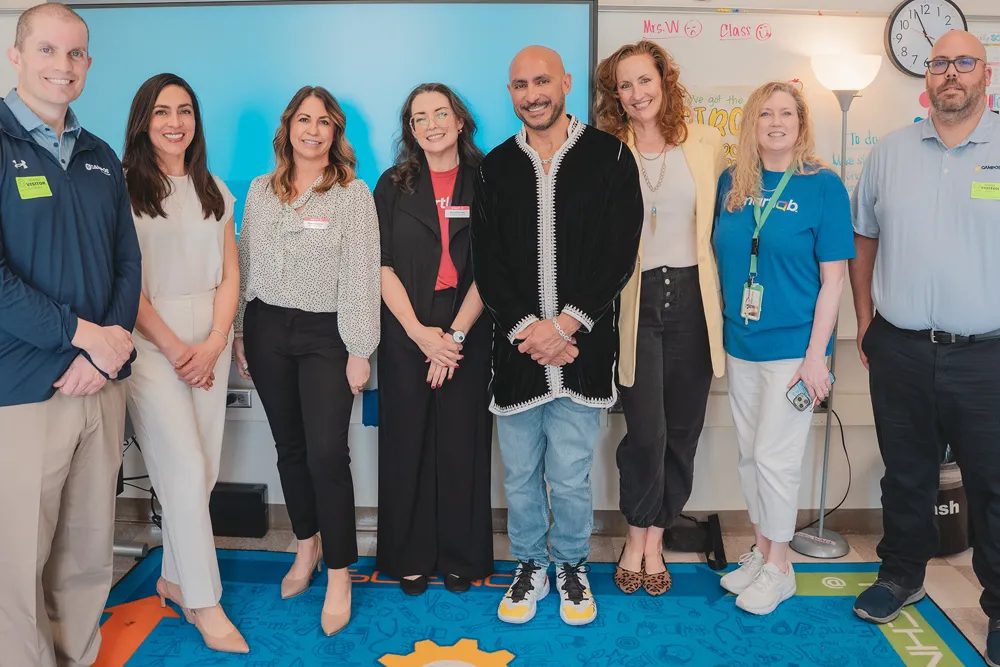
Community partners—whether they’re local manufacturers, foundations, healthcare systems, or civic organizations—bring something schools can’t purchase: proximity to careers.
This can look like:
- Career talks and employee visits: Industry professionals in the room with students, making the career paths discussed in class feel more within reach
- Mentoring relationships: Consistent connections with professionals that can help students envision themselves in similar roles one day
- STEM Identity Day participation: Volunteer at or sponsor this national initiative, which connects students with STEM professionals to help them see what’s possible
- Internships and field trips: Experiences that reinforce classroom learning by demonstrating how concepts are applied in practice
SmartLab partnerships are mutually beneficial. Schools gain resources, connections, and credibility while partners benefit from visibility within the community, the ability to have a hand in developing a future workforce pipeline, and the kind of authentic engagement that’s hard for an advertising budget to reproduce.

Partnerships in Action: MidAmerica Industrial Park
MidAmerica Industrial Park is Oklahoma’s largest, and it is home to leading manufacturing, energy, and technology companies. For years, one of the most persistent challenges facing employers in northeast Oklahoma was rooted in the reality that the area’s rural students had limited access to the kind of career-connected learning that could prepare them for STEM roles.
In response, MidAmerica partnered with SmartLab to build a network of nine in-school STEM labs across the region.
An independent evaluation conducted by PEAR (Partnerships in Education and Resilience) later found that across 610 students served by MidAmerica’s Smartlabs, STEM career knowledge saw the greatest gains. Students also reported stronger critical thinking and perseverance while educators felt more confident and capable leading hands-on learning experiences.
What made the partnership successful was a combination of project-based curriculum aligned to industry pathways, professional-grade tools, and ongoing educator support, with a partner who understood that the community’s future workforce was waiting in local classrooms.
The best part? These results can be replicated wherever a committed industry partner and a school system share the same goals.

“SmartLabs are designed to engage students through hands-on learning. This project-based learning allows students to build critical thinking skills with a STEM curriculum. One of the long-term goals of The Weld Trust is to help remove barriers to learning for students to be successful in school. The interactive learning environment fostered by SmartLab allows students to learn in ways that are unique to their interests and keeps them engaged.”
How to Start the Conversation With Potential Partners
For school leaders thinking about how to fund STEM education through community partnerships, some of the first questions to answer are “Who should we approach?” and “How can we ask for funding?”.
Here’s where to begin:
Start with mission alignment.
Look for companies in industries already represented in SmartLab’s career-connected curriculum (such as advanced manufacturing, health sciences, construction, and technology). Foundations focused on education or workforce development are another potential match. Finally, civic organizations that are already predisposed to community investment (Rotary chapters, for example) tend to look for the exact kind of structured impact a SmartLab partnership provides.
Frame the ask around shared outcomes, not school need.
The conversation shouldn’t start with your funding woes. Instead, frame the conversation around what the partner gains from their investment—access to a future talent pipeline, opportunities for brand visibility, the chance to make a positive community impact, and the ability to shape the STEM identity of the next generation of their industry.
Remember, you don’t have to do this alone. Our partnerships pages (here and here) can help guide your conversations. Plus, our team of funding experts can help you identify and approach potential community partners.
The Long View: Sustainability Is the Goal
A SmartLab partnership is meant to change the structural conditions that can make STEM programs fragile.
Ongoing professional development means that the program survives staff turnover. The Innovation Fund is in place so the program can grow and adapt as technology and the curriculum evolve. Partners can deepen their investment over time, moving into greater tiers of support as they see results and build relationships with the school community.
Perhaps most notably, when a community partner is invested in a program, the program belongs to the community in a way that extends beyond this year’s budget or the current school administration. That kind of security is arguably more valuable than what any single grant provides, and it’s why funding STEM education through strategic partnerships is one of the most durable approaches available.

“Our world is changing every day, and education has to change with it. Students need opportunities to learn skills that connect to what the workforce actually needs. What excites me about SmartLab is that students are developing practical, transferable skills that will help fill workforce pipelines and strengthen our community. They’re also building communication, collaboration, and critical thinking skills that apply to any career.”
Partnerships Are How STEM Programs Stay Afloat
For school leaders who are weighing whether to invest the time and energy in building community partnerships to fund STEM education, the question isn’t whether you can afford to pursue them, it’s whether you can afford not to.
The schools that create lasting, high-impact STEM programs are the ones that have community involvement. Yes, securing a big, one-time grant can help, but the true staying power comes from the stability of a fully invested partner and a model that gives everyone involved a reason to stay engaged.
SmartLab supports that kind of model—for schools, partners, and most importantly, the students.
Ready to learn how SmartLab helps schools build community support? Get in touch with our team today.
Become a SmartLab Partner
Help Build the Future Workforce, Starting in Today’s Classrooms
A SmartLab partnership is more than a sponsorship. It’s an opportunity to connect students with meaningful STEM experiences while strengthening your community and investing in tomorrow’s workforce. Discover how your organization can help schools create lasting impact through career-connected learning.