Education Grants: A Complete Guide to Finding and Securing School Funding
In the search for funding for educational programs (including STEM programs), education grants are an invaluable resource for all schools, including public and private kindergarten, elementary, middle, and high schools. Educational grants provide important financial support to address budget shortfalls, finance critical projects, and extend access to high-quality learning experiences.
For STEM programs in particular, grants are a crucial support system, whether you’re a teacher seeking classroom supplies, a principal investing in technology and learning environments, or a district working to build equitable access to integrated, career-connected programming.
Even if you’re not actively pursuing grant money for school, it’s important to understand your options, including federal funding, state funding, nonprofits, and private funding. At SmartLab, we have worked alongside educators and district leaders as they searched for, applied for, and implemented grant-funded STEM initiatives designed for long-term impact. Here is what you need to know about exploring funding pathways, identifying the right opportunities, and securing sustainable support.
What Is an Education Grant?
An education grant is a form of financial assistance awarded to schools, districts, educators, or educational organizations to fund specific programs, projects, or initiatives. Unlike loans, grants do not need to be repaid, provided the funds are used in accordance with the terms of the award.
Educational grants can come from a variety of sources, including federal and state governments, nonprofit foundations, and private corporations. Depending on the grant, they can support a wide range of needs, such as curriculum development, instructional technology, classroom materials, professional learning opportunities for teachers, and the creation of dedicated learning environments.
Without the burden of repayment, education grants are one of the most impactful tools available to schools and districts looking to expand access, strengthen programs, and create valuable learning experiences for students.
Types of Educational Grants
Education grants vary widely in their source, scope, and purpose. Understanding the different types available can help educators and administrators identify the right opportunities for their specific needs and goals.
- Federal grants are funded by the U.S. government and are among the largest and most widely available sources of educational funding. They are typically distributed through agencies such as the U.S. Department of Education or the National Science Foundation. They are often targeted toward public schools, districts, and nonprofit institutions serving underserved student populations.
- State education grants are administered through a state’s department of education. They commonly support state-specific priorities such as technology access, teacher development, curriculum innovation, or school improvement, and offer a strong complement to federal funding.
- Sometimes, nonprofit organizations will offer grants that are related to their own missions, ranging from early literacy and arts education to STEM programming and teacher professional development. These awards are often smaller in size, but can be highly targeted and easier to access than federal or state funding.
- Many corporations and private foundations maintain giving programs that fund educational initiatives, particularly those aligned with workforce development and community impact. These grants can also open doors to longer-term partnerships between schools and local businesses or industries.
- STEM-focused grants support programs in science, technology, engineering, and mathematics. They may come from federal agencies, private corporations, nonprofit organizations, and other sources, and are often designed to expand access to hands-on learning, career-connected experiences, and technology-rich environments.
- Arts and humanities grants fund programs in the visual arts, music, theater, media, and the humanities. Sources include the National Endowment for the Arts, the National Endowment for the Humanities, state arts councils, and private foundations with a focus on creative education.
- Literacy grants support reading, writing, English language learners, and students in under-resourced communities. They are typically available through federal programs, nonprofit organizations, and corporate giving initiatives.
- Special education grants are designed to support students with disabilities, and the educators who serve them. Federal programs such as IDEA (Individuals with Disabilities Education Act) are a primary source, though nonprofit and private funding opportunities also exist in this space.
What Educators Need to Know About STEM Grants for Schools
While most government and private grants for education are targeted toward public schools and districts (also referred to as Local Education Agencies or LEAs), grants do exist for both nonprofit and for-profit private schools. The most important step in securing grants for private schools or for public education is to determine if you’re eligible.
- First, decide if you’re applying as an individual educator or if you’ll be representing a larger organization, such as a club, department, or even your entire school or district. Once you know this, you’ll need to check your eligibility to apply.
- All grants have a section in the official grant announcement explaining eligibility. To determine your eligibility, you’ll need to review the requirements of who the grant was established for and what the money will be used for:
- Most grants are established to help public schools cover costs and support the educational experience — especially those schools with at-risk or low-income student populations.
- Nonprofit schools, especially those with 501(c)(3) status, also are generally eligible for a higher number of grants.
- Private and for-profit schools will have the fewest grant options to apply for, but opportunities do exist. These schools just may have to work a little harder to establish their eligibility.
- If you are a school that is a part of an LEA or district, check with your principal to determine which grants are acceptable to apply for. This is especially true if the grant affects elements like staffing, professional development, investments in technology, or other resources for the district since applying for the grant could complicate other funding efforts. Your LEA may have funding restrictions or limitations, so be sure to check and secure approval before making any applications.
- Note that some grants also require the LEA to be the lead fiscal agent, which is the organization that agrees to accept and maintain responsibility for grant funds on your behalf. In this case, school principals are often able to liaise with school district officials to secure approval to apply for the funding. For more details on fiscal agents, see this overview from the NEA Foundation.
- In addition to the grant guidelines and eligibility criteria, you also want to research the deadlines. Grants submissions may require additional documents, attachments, or other forms. You don’t want to wait until the last minute to submit in case there are any oversights or technical issues.

Tips for Applying to STEM Education Grants
Have you found a grant that supplies funding for STEM programs that you would like to apply to? Here are some helpful tips to guide you through the application process:
- Carefully consider your school’s eligibility for the grant and consult with your principal or district leadership team early. If you are not eligible for a specific funding opportunity, or if there is misalignment with district priorities or local education agency (LEA) requirements, you risk investing time and resources into an application that cannot move forward.
- Start your grant application with a clear understanding of what you want to achieve with the funding. Define measurable goals, intended student outcomes, and long-term impact. Strong proposals not only describe what will be purchased, but also explain how the investment will strengthen instructional quality, expand access, and support sustainable STEM implementation. Tailor your proposal to address the grantor’s priorities and clearly demonstrate alignment.
- Understand that grants follow a lifecycle that extends well beyond the application itself, and each phase carries responsibilities that require planning and capacity. Generally, there are three phases:
- Pre-Award Phase: This period begins after the submission deadline while proposals are being evaluated. Some grantors may request interviews, clarifications, or site visits. Be prepared to clearly articulate your implementation plan, expected outcomes, and how success will be measured.
- Award Phase: This is when the official award decisions are released. If your application is not successful, consider requesting feedback to strengthen future proposals. If you are awarded the grant, acceptance means committing to the full scope of work, reporting requirements, and implementation plan described in your proposal.
- Post-Award Phase: After receiving funding, implementation and accountability become the priority. Many grants require documented data collection, process reporting, and evidence of outcomes. Some may also require an audit (or audits) and/or formal impact reports detailing how funds were used and what results were achieved.
- To build on this point, be sure you fully understand the reporting and evaluation commitments before accepting the award. Depending on the grant, these responsibilities may extend for multiple years and require coordination across instructional, administrative, and finance teams. Planning for sustainability from the outset helps ensure the investment delivers lasting value.
Blending and Braiding for STEM Funding
Maximizing support for STEM initiatives often requires combining multiple funding sources in a coordinated and strategic way. Two key strategies for this are blending and braiding. When aligned to a clearly defined instructional vision and measurable student outcomes, these approaches can significantly enhance both the financial stability and long-term impact of a STEM program.
- Blending: Combining funds from multiple sources into a single, unified pool to support a cohesive STEM initiative. For example, merging Title IV funds with local tech company donations to create and sustain a comprehensive STEM learning environment that includes curriculum, professional learning, and student experiences.
- Braiding: Coordinating multiple funding sources, each with its own set of regulations, to support a single initiative while maintaining distinct tracking and reporting for each source. For example, using Title I funds to expand access for underserved learners while leveraging corporate grants to support tools, training, or industry-connected experiences within the same STEM program.
How to Write a Winning STEM Grant Proposal
A grant proposal is the core component of your grant application. It should clearly articulate what you want to accomplish, why the initiative matters for students, and how the requested resources will translate into measurable academic and workforce-connected outcomes. A strong proposal demonstrates alignment with the grantor’s mission while outlining a practical, sustainable plan for implementation.
Whether you’re applying for a small classroom-level innovation grant or a district-wide STEM initiative, a well-structured proposal can make all the difference. Best practices include:
- Starting with a clear, compelling need: Describe the challenge your students or school is currently facing. Use relevant data, such as enrollment trends, achievement gaps, workforce demands, or access disparities to demonstrate urgency and long-term impact.
- Aligning your goals with the grantor’s priorities: Show that you understand the funder’s mission, and explain how your proposed initiative advances their objectives while strengthening student outcomes.
- Be specific about your objectives and expected outcomes: Avoid overly broad statements such as “improve STEM engagement.” Instead, define measurable targets: increased participation in advanced STEM coursework, demonstrated growth in problem-solving skills, or improved proficiency in computational thinking, to name a few.
- Provide a thorough plan of action: Explain how the initiative will be implemented, who will be involved, how professional learning will support educators, and how progress will be monitored. Funders look for clarity, feasibility, and accountability.
- Create a realistic and transparent budget: Break down expenses clearly and connect each line item to instructional goals. Include curriculum, professional learning, materials, and sustainability planning where applicable.
- Highlight viability: Describe how the initiative will continue beyond the initial funding cycle. This may include blended funding strategies, district budget alignment, community partnerships, or ongoing professional learning.
- Include strong evidence of support: Letters from administrators, educators, community partners, or industry advisors can demonstrate readiness, alignment, and shared commitment.
What to Include in a STEM Grant Proposal
While every funding opportunity varies slightly, most STEM grant proposals include:
- Executive summary: A concise overview of your initiative, intended outcomes, and funding request
- Needs statement: The specific challenge you are addressing and its impact on student learning, access, or long-term opportunity
- Project description: A clear implementation plan that outlines instructional design, educator support, timeline, and intended student experiences
- Objectives: Measurable goals that define how success will be evaluated and sustained over time
- Budget: Itemized costs with a clear connection to student outcomes and program sustainability
- Supporting documents: Such as letters of support, research citations, vendor quotes, curriculum outlines, or evaluation frameworks
Avoiding Common Mistakes in STEM Funding Applications
Even the strongest initiatives can be overlooked if the application contains preventable errors. Understanding (and avoiding) what commonly goes wrong can significantly increase your chances of securing funding for a sustainable, high-impact STEM initiative.
- Not following the application instructions exactly Many proposals are rejected simply because applicants exceed page limits, fail to provide required attachments, or ignore formatting rules.
Tip: Treat the instructions like a compliance checklist and have a colleague review your submission for completeness and accuracy before submitting. - Submitting a “one-size-fits-all” proposal Reviewers read hundreds of grant applications and can quickly identify proposals that are not tailored to their organization’s priorities.
Tip: Customize every proposal to the specific funder, especially when describing goals, measurable outcomes, sustainability plans, and long-term impact. - Failing to clearly articulate the problem you’re solving Without a strong, data-informed needs statement, funders may struggle to understand the urgency or relevance of your initiative.
Tip: Use student performance data, access gaps, demographic information, or local workforce trends to demonstrate both immediate need and future opportunity. - Featuring overly vague or broad outcomes Statements, such as “increase STEM learning” or similar don’t show reviewers what success for your program looks like.
Tip: Define measurable outcomes tied to student growth, implementation fidelity, or long-term program sustainability. Use SMART goals that specify what will improve, by how much, and within what timeframe. - Presenting budgets that don’t align with the project A budget that seems inflated, incomplete, or disconnected from your program’s goals can undermine credibility.
Tip: Ensure each budget item directly supports student outcomes, educator implementation, or sustainability planning. Provide a clear rationale for every expense. - Waiting until the last minute Technical issues, missing approvals, forgotten attachments, or incomplete responses are more likely when timelines become compressed.
Tip: Build in time for internal review, district approvals, and alignment checks to ensure your proposal reflects both instructional clarity and organizational readiness.
Top STEM Funding Sources
You can find more detailed information about education grants at grants.gov, including definitions of terms, process overviews, and current funding opportunities. As for identifying the right grants for your STEM initiative, we have organized the landscape into five major categories of funding:
- Federal
- State
- Nonprofits
- Private
- Other
You don’t have to do it all yourself. Download the SmartLab Sustainable STEM funding guide here, and let us know if you’d like help from a specialist to fund your SmartLab.
When it comes to funding your STEM initiative, you don’t have to navigate the process alone. Download the SmartLab Sustainable STEM funding guide here to explore long-term funding strategies, and let us know if you’d like support aligning your STEM vision to sustainable funding pathways.
Federal Grants and Funding
As the largest supplier of government grant funding for schools, the U.S. federal government features several departments, agencies, and foundations that provide financial assistance. Federal grants exist for state and local educational agencies, K-12 schools, community and faith-based organizations, and nonprofit entities involved in education.
Explore the following federal STEM grant opportunities:
- National Science Foundation (NSF): This independent federal agency is one of the primary funding bodies for scientific research and STEM education in the United States. The NSF focuses on advancing scientific knowledge, fostering innovation, and expanding high-quality STEM learning opportunities. NSF grant resources include:
- U.S. Department of Education (DoE): This department oversees and implements federal education policies and administers significant federal funding to states, districts, educational institutions, and nonprofit organizations. These grants support teacher training, literacy programs, school improvement, and STEM-focused initiatives.
- U.S. DoE grant opportunities
- Office of Elementary & Secondary Education (OESE): This office within the DoE oversees federal programs related to elementary and secondary education and distributes funding that supports K–12 instruction, school improvement, and innovation.
- OESE programs and grants listed by office
It is important to note that while federal grants are widely available, they often come with complex eligibility criteria, reporting expectations, and compliance requirements. For many districts, aligning federal funding with long-term STEM implementation and measurable outcomes requires careful planning. For that reason, regional and state funding sources may offer greater flexibility depending on your district’s needs.
State Grants and Funding
Many states recognize the importance of STEM education and offer targeted grants that support equipment, professional learning, curriculum development, and student programming. Understanding and leveraging these opportunities can significantly strengthen and sustain your STEM initiatives.
Common State STEM grant categories include:
- Equipment and Technology: Funding for lab equipment, computers, and software
- Teacher Professional Development: Support for STEM-focused training and instructional coaching
- Curriculum Development: Resources to create or enhance standards-aligned STEM learning experiences
- STEM-Focused Programs: Grants for robotics clubs, coding courses, engineering challenges, and career-connected initiatives
Begin your search on your state’s department of education website for consolidated listings of available funding. For example, in Colorado, many schools apply for the BEST Grant Program to renovate, update, or build learning environments that support modern instructional models.
Securing state funding can be a powerful strategy for long-term program sustainability, but it requires coordination and oversight. Districts benefit from assigning clear roles for funding management, reporting, and cross-department alignment. See The Grantsmanship Center for an overview of specific grant resources on a state-by-state basis.
After you’ve explored available funding opportunities on the state level, your next step should be to see what’s available in terms of nonprofit and private grants.
Nonprofit Grants and Funding
Philanthropic and nonprofit organizations frequently offer grants to support STEM education. These awards are often smaller than government grants, typically ranging from a few hundred to several thousand dollars. While a single nonprofit grant may not fully fund a comprehensive STEM initiative, these opportunities can supplement broader funding strategies.
Many nonprofit grants include highly specific eligibility requirements, so having a clearly defined initiative, measurable outcomes, and a sustainability plan strengthens alignment and competitiveness. Award timelines vary widely, so conducting regular searches is recommended.
Examples of established nonprofit grant programs include:
- American Association of Educators Scholarships and Grants
- American Association of School Librarians Innovative Reading Grant
- NEA Learning & Leadership Grants
- McCarthey Dressman Education Foundation Teacher Development Grants
- Gravely and Paige Grants for STEM Teachers
- Fund for Teachers
For further exploration, visit grant funding aggregate sites such as GrantWatch.
Private Grants and Funding
Many corporations and private enterprises maintain philanthropic programs that support education and workforce development initiatives, including STEM. Private funding can also create opportunities for community partnerships, local visibility, and alignment with regional workforce needs.
Local funders are often easier to meet with and are more likely to be invested in community impact. Strong partnerships can demonstrate instructional and workforce alignment while creating long-term collaboration opportunities. Building relationships with business and industry partners requires intentional outreach, clear communication of measurable impact, and shared goals around student success. Consider these three key strategies on how to establish, maintain and grow your relationships with businesses and corporations:
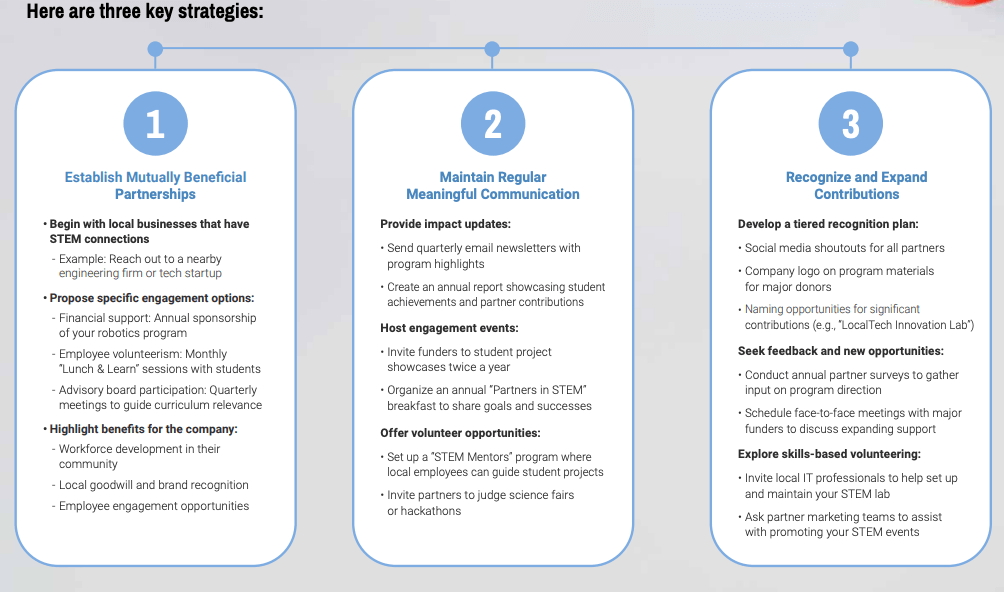
Like nonprofit funding, there’s no set timeline for private grants, and they aren’t always offered consistently. Conduct regular searches or consult with your school’s principal or a member from the LEA for leads. The following are examples of grants for schools offered by major national corporations:
Some organizations that SmartLab has worked with include:
- Gill Foundation: A leader in funding for equity in schools with a mission to secure equality for LGBTQ students
- The Success Foundation: A private donor committed to advancing PK-12 education in the 6th congressional district of Colorado
- Campos EPC: A Denver-based leader in energy infrastructure dedicated to supporting future engineering and construction professionals
- MidAmerica Industrial: A Tulsa, Oklahoma industrial park invested in providing local students with skills needed for the workforce
For more information on these private donors and other funding partners we’ve worked with, see the SmartLab page on education grants and other funding opportunities.
Other Sources of Funding
While grants are often the largest and most visible sources of education funding, they are not the only option. Diversifying funding streams can strengthen long-term sustainability, especially when incorporated into a blended or braided strategy that supports both program launch and ongoing implementation.
Crowdfunding
With the rise of digital platforms, crowdfunding has become a viable way to supplement STEM program funding while building community engagement. Online campaigns can generate both financial support and local visibility. However, because funding amounts are not guaranteed and typically smaller in scale, crowdfunding is best suited for targeted enhancements, classroom-level needs, or pilot projects rather than comprehensive program expansion.
Popular crowdfunding sites include DonorsChoose and We Raise Foundation.
Self-sustaining Entrepreneurship
Self-sustaining entrepreneurship puts a STEM twist on the traditional student fundraising. Instead of selling baked goods or magazine subscriptions, students create and sell their own STEM-related products or services. Students might sell 3D-printed mascots or laser-cut keychains at events, design educational apps, or offer tech support services and workshops within the community. This model not only supports program funding but gives students practical business experience.
Alumni Contributions
Reaching out to school alumni for donations and contributions can help with STEM program funding, supporting projects, and infrastructure improvements. Developing and maintaining a robust alumni network takes time and effort, but it can be well worth it. Organizing outreach for donations and hosting fundraising events can raise your program’s profile within the community while bringing in funds.
Strategic thinking can unlock STEM funding opportunities even when traditional grants are limited. Read this case study to see how one educator leveraged creativity, partnerships, and long-term planning to fund a new SmartLab learning environment for her students.
Consider a STEM Advisory Board
Sustainable funding and long-term program success require coordination across multiple stakeholders. Establishing a STEM advisory board can provide structure, industry insight, and strategic support that strengthen both funding efforts and instructional relevance.
Composed of 8–12 diverse members from industry, education, and community, a STEM advisory board would offer direction in:
Designing high-impact STEM events: Board expertise can elevate STEM showcases, design challenges, and community events by incorporating authentic industry problems and external evaluators, reinforcing rigor and visibility.
Aligning the program with workforce needs: Industry board members can provide insights on skills gaps, emerging technologies, and job market trends, helping shape curriculum to meet real-world demands.
Providing real-world connections for students: Board members can open doors to their companies and networks, facilitating job shadows, guest speakers, and collaborative projects that bring STEM concepts to life.
Supporting funding strategy and grant development: Members can help identify grant opportunities, contribute letters of support, connect schools with potential funders, and strengthen applications through industry credibility.
STEM Education Grant FAQs
What types of STEM grants are available for public schools?
STEM education grants for public schools can come from federal, state, and local government sources, as well as private foundations and organizations. The availability of specific grants varies based on factors such as school location, student demographics, program design, and alignment with workforce and innovation priorities.
Is my private school’s STEM program eligible for funding from grants?
While many education grants prioritize public or nonprofit institutions, private and for-profit schools may still have access to funding opportunities. Local education foundations, corporate giving programs, and regional philanthropic organizations can be strong starting points when exploring eligibility.
Can I apply for multiple types of grants to fund STEM education at my school?
Yes, you don’t have to rely on just one source for your grant money. Rather than trying to secure all your funding from one grant, it’s pretty common to apply to multiple grants from different sources. You can take what’s called a “blend and braid” approach by combining two or more funding streams.
- Braided funding combines multiple funding streams toward one purpose while separately tracking and reporting on each source of funding.
- Blended funding combines multiple funding streams for one purpose and does not differentiate or track individual sources.
What federal grants is my school’s STEM program eligible for?
Your school’s eligibility for federal grants will vary based on factors such as the school’s location, student population, and specific needs. To see which grants you may qualify for, start by visiting the websites of federal grant programs that are commonly available to public schools, such as the U.S. Department of Education’s Grant Programs webpage and Grants.gov.
What private grants is my school’s STEM program eligible for?
There are a lot of private grant opportunities for schools, and they change every year. Start by researching private foundations, corporations, nonprofit organizations, and community groups that offer grants in the field of education. Consider visiting Candid Search (formerly the Foundation Center’s Foundation Directory) to start your search.
What is STEM program funding?
STEM program funding refers to financial support (typically provided through grants, donations, fundraising, or special initiatives) that helps schools create, expand, or sustain programs focused on science, technology, engineering, and mathematics. These funds can be used for a wide range of needs, including lab equipment, curriculum materials, professional development for teachers, student enrichment activities, and the creation of STEM learning environments.
How do schools apply for STEM grants?
Schools apply for STEM grants by identifying eligible funding opportunities, carefully reviewing program requirements, and submitting proposals that clearly outline the need, instructional goals, measurable outcomes, budget alignment, and sustainability plan.
What are the best funding sources for STEM education?
The best funding sources for STEM education vary depending on your school’s needs, eligibility, and location, but most grant opportunities fall into five major categories: federal grants, state grants, nonprofit grants, private and corporate grants, and other funding sources. The strongest and most sustainable STEM initiatives typically rely on a diversified funding strategy that blends multiple sources to support long-term implementation, measurable outcomes, and ongoing educator support.
Talk to SmartLab about Creating Opportunities for STEM Grants
In recent years, the focus of STEM education has evolved. The goal is no longer to simply prepare students for specific STEM careers, but instead to develop STEM literacy, problem-solving capacity, and the ability to apply integrated skills across industries.
Securing funding plays a critical role in building programs that move beyond isolated activities toward cohesive, sustainable learning ecosystems. Grants can support instructional design, educator professional learning, hands-on tools, and learning environments that help students build durable skills and real-world connections.
If you are exploring how to align funding with long-term STEM strategy, download our funding guide or connect with our team to discuss how to structure a sustainable approach for your district.